

As the calendar turns, I find myself thinking less about resolutions and more about reflection. Living and working in diabetes means every year brings new technology, new data, and new promises—but it also brings the same daily realities that don’t reset at midnight.
It is, in many ways, an exciting time to have diabetes (did I really just say that?). What I mean is that diabetes management looks vastly different for my son than it did for me. Each year seems to bring meaningful advances—devices that talk to one another, data that updates in real time, and tools designed to fit into life rather than dictate it.
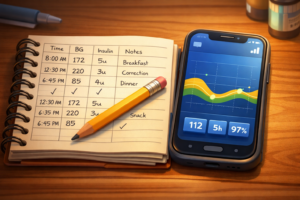
When I was diagnosed, everything revolved around the numbers—blood glucose numbers. And perhaps that was partly because we struggled just to know what those numbers were. Management often meant living around the regimen rather than the other way around. Structure came first; flexibility came later, if at all.
Now, we have the data—all the data. Trends, patterns, time-in-range, predictive alerts. The focus has shifted from isolated numbers to context and understanding. That shift has changed diabetes care in important ways, but it hasn’t made the work effortless.
Because while diabetes management continues to evolve, the emotional load doesn’t disappear.
If anything, that emotional side is one of the areas where the biggest change has occurred, not because it vanished, but because it finally became visible. When I was in college, I remember running and feeling like I was the only one with diabetes. I wasn’t, of course, but how would I have known? There was no social media, no online communities, no nonprofits focused on daily life with diabetes rather than just fundraising. There was no easy way to find people who “got it.”

Today, that landscape looks very different. There are communities for people with diabetes who love sports, for diabetes moms and dads, for kids, for caregivers, even for families with diabetes-trained dogs. There is connection where there once was isolation, and that matters.
As this year comes to a close, I’m reminded that progress in diabetes isn’t measured only in better numbers or newer devices. It’s also found in shared experiences, honest conversations, and the growing recognition that managing diabetes is as much emotional as it is clinical.
That’s what I’m carrying into the new year: gratitude for how far we’ve come, respect for how hard this still is, and hope that we continue to build systems, and communities, that support the whole person, not just the data.