
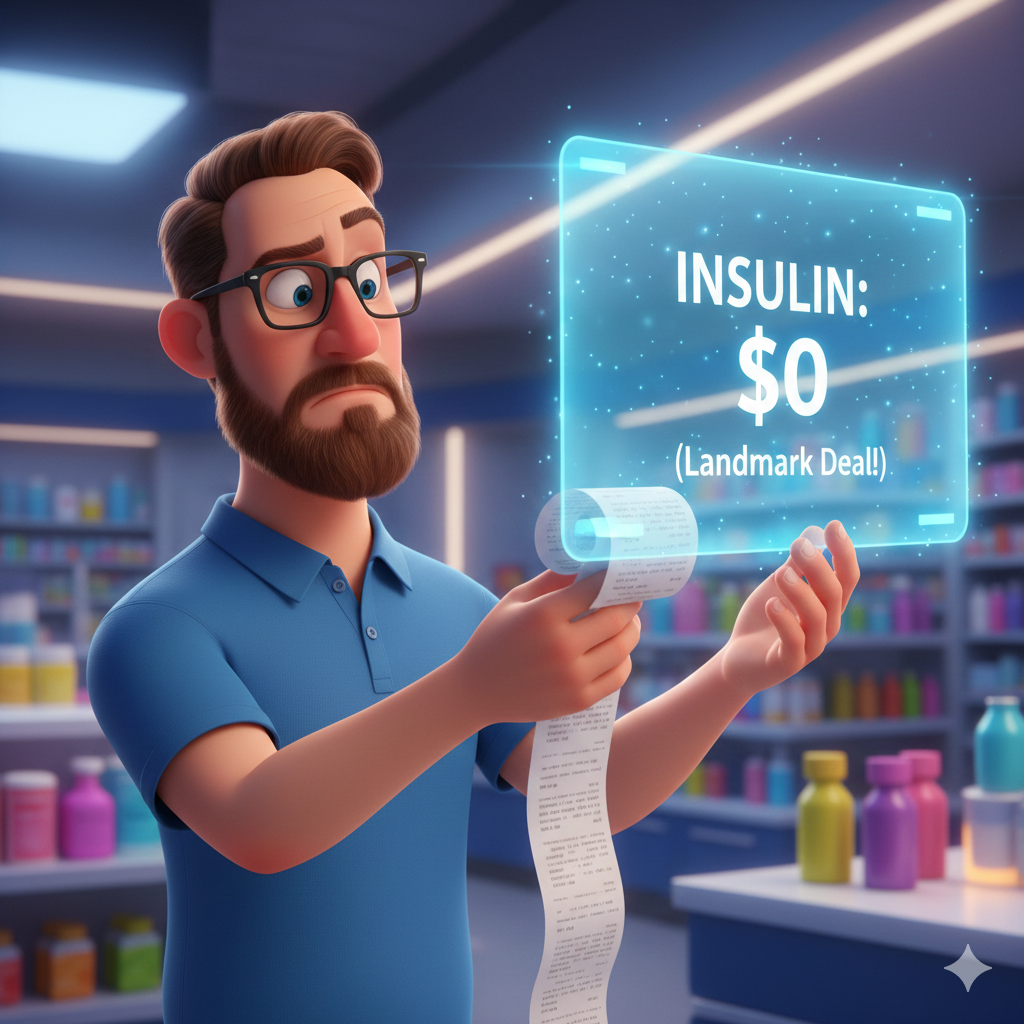
Every once in a while, a healthcare headline comes along that makes people do a double-take.
“FTC Secures Landmark Settlement with Express Scripts to Lower Drug Costs for American Patients.”
That’s right. Landmark. Lower drug costs. Insulin. Accountability.
Cue the record scratch.
If you’ve spent any amount of time in the diabetes space, as a patient, parent, clinician, educator, or anyone who has ever stood at a pharmacy counter holding a receipt, then you know insulin affordability has been a long-standing concern. Over the last 20 years, insulin list prices increased substantially across the marketplace, with estimates ranging from 184% to 600%, depending on the analysis. While net prices and rebates tell a more complex story, the out-of-pocket experience for many patients has often remained difficult.

When gasoline prices rise, news outlets talk about “pain at the pump.” Well, if you use an insulin pump, that phrase suddenly feels a little too on the nose.
So yes, I want to acknowledge upfront that this really is a landmark decision. But just like when I step on the scale when I’ve had an active week after Super Bowl Sunday, we should read these headlines with cautious optimism. Because while this settlement sounds like a win, and in many ways, it is, But healthcare policy has a long history of producing promising headlines that require careful examination before their real-world impact becomes clear.
So let’s talk about what this actually means, why it matters, and why the devil is already sharpening his pitchfork, or in this case, a big 18-gauge needle, in the details.
What Just Happened, in Plain English
The Federal Trade Commission (FTC) reached a settlement with Express Scripts, one of the three major pharmacy benefit managers (PBMs) that play a central role in negotiating drug pricing and managing formularies.
The FTC alleged that rebate-driven contracting practices contributed to higher insulin list prices by favoring products that generated larger rebates within formulary structures.

Under the settlement, Express Scripts must:
- Stop favoring higher list-price drugs when identical lower-cost versions exist
- Offer plans where patient cost-sharing is based on net price, not list price
- Delink manufacturer compensation from list prices
- Increase transparency to plan sponsors
- Shift pharmacy reimbursement to acquisition cost plus a dispensing fee
- Expand access to insulin affordability programs
- Reshore its massive group purchasing organization back to the U.S.
The FTC estimates this could reduce drug costs by up to $7 billion over 10 years.
That’s a lot of cupcakes.
Why This Is Actually a Big Deal
For years, PBMs have described their role as negotiating discounts, managing formularies, and lowering overall system costs. And in many cases, negotiated rebates have reduced net spending for plan sponsors.
However, rebate structures tied to list prices also created complex incentives within the system.
In many benefit designs:
- Manufacturers increased list prices to offer larger rebates
- PBMs negotiated those rebates
- Patient cost-sharing was often calculated from the higher list price
- Employers used rebates to offset premiums
The result was a system in which savings did not always translate into lower out-of-pocket costs at the pharmacy counter.
By requiring Express Scripts to offer models based on net prices, the FTC is directly addressing these incentive structures. That represents a shift in how pharmacy benefit economics may operate going forward.
So Why Am I Still Nervous?
Healthcare reform rarely fails loudly. More often, it evolves gradually through optional adoption, contract cycles, and implementation details. Several factors will determine whether this settlement meaningfully improves affordability.
Adoption is not Automatic
Most of the reforms Express Scripts agreed to are offerings, not mandates. Translation: employers and plan sponsors still have to choose them.
Employers and plan sponsors must choose to adopt these net-price models. Some likely will. Others may prioritize premium stability or existing contract structures.
Patient savings will depend heavily on how benefit designs evolve over time — and those changes typically align with renewal cycles, not press releases.
Premium vs. Point-of-Sale Tradeoffs
Rebates have historically been used to offset premiums.
If rebate-driven revenue declines:
- Drug pricing at the point of sale may become more transparent
- Premium structures may shift in response
Employers balancing total healthcare costs may weigh those tradeoffs carefully.
Savings in one part of the system can create financial pressure elsewhere, complicating reform adoption even when the long-term intent is positive.
Revenue Models Will Adapt

Large organizations adjust when regulatory frameworks change.
If rebate structures decline, alternative revenue mechanisms may emerge — such as administrative fees, value-based arrangements, or expanded service models.
The long-term impact of this settlement will depend not only on regulatory language but on how contracts and business models evolve under the new framework.
Insulin Is the Starting Point Not the End Game
Insulin is a logical focus for reform. It is clinically essential, widely used, and politically visible. But the broader question is whether similar pricing logic will extend to:
- GLP-1 therapies
- Specialty medications
- Oncology drugs
- Biosimilars
If insulin reform becomes an isolated solution rather than a template, the overall impact may be limited.
How Long Until Patients Feel It?
Even after the 30-day public comment period, implementation will be phased. Realistically:
- Some transparency requirements may kick in quickly
- Structural changes will take 6–18 months
- Many plans won’t see changes until the next plan year
This is unlikely to produce immediate shifts at the pharmacy counter. It is better understood as a structural recalibration than an overnight transformation.
What This Means for People with Diabetes

In the near term, some patients may experience lower insulin out-of-pocket costs. Others may see minimal change, depending on their employer-sponsored plan.
In the longer term, this settlement increases transparency, establishes precedent, and signals heightened regulatory attention toward PBM incentive structures.
Express Scripts is one of three major PBMs, alongside Caremark and OptumRx. Whether this settlement becomes an isolated agreement or part of broader industry reform remains to be seen.
Because Express Scripts isn’t the endgame, it’s the first domino.
Final Thought: Measured Optimism
This settlement represents real progress. It moves beyond discussion and addresses incentive design directly. But implementation will determine impact.
If employers adopt net-price models, enforcement remains strong, and similar reforms extend across the market, this could mark a meaningful shift in pharmacy benefit economics. If adoption remains limited, the structural impact may be more modest.
Healthcare reform is rarely defined by headlines alone. It is defined by how contracts change, how benefits evolve, and whether patients ultimately experience relief at the pharmacy counter.
For now, cautious optimism is reasonable, paired with close attention to what happens next.
Click the link from the American Journal of Managed Care to read more about this decision.