
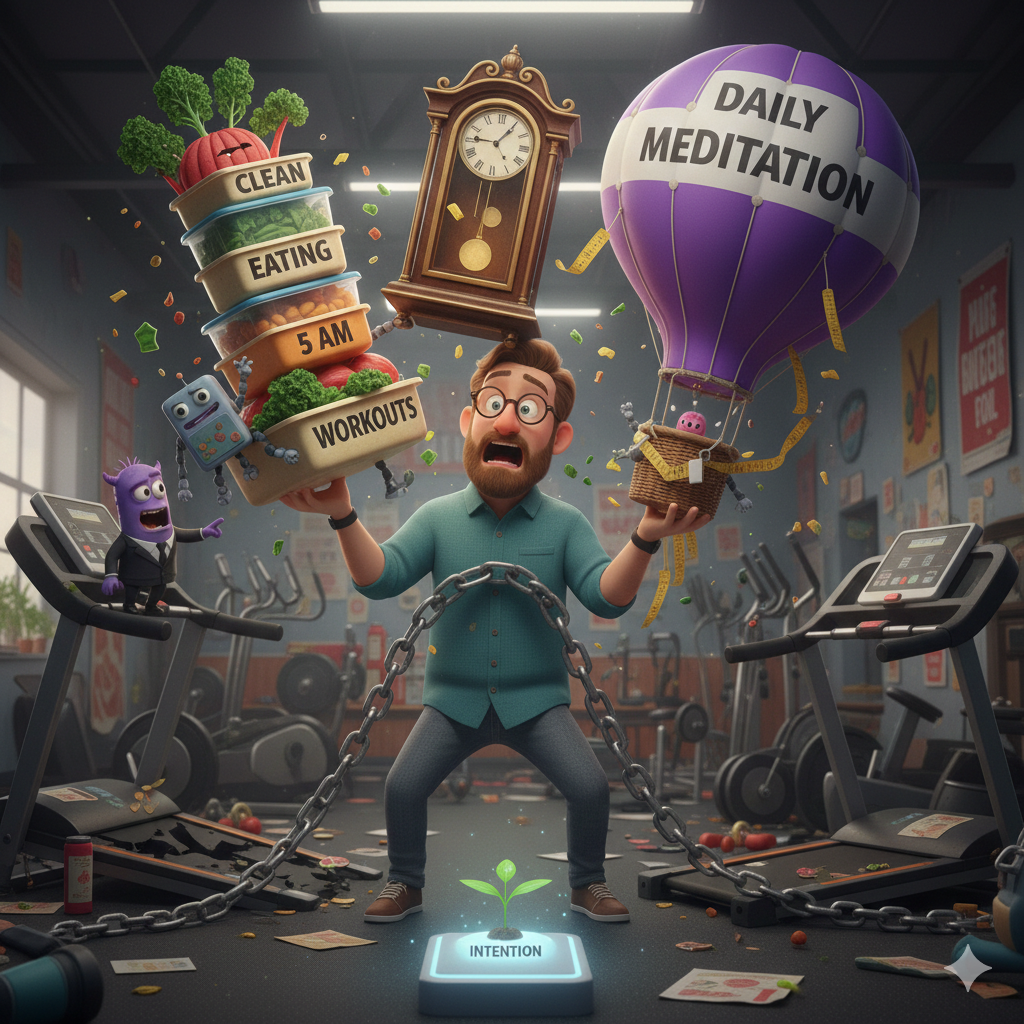
If you read my article on January 12th and thought, “Okay, fine. I get it. Resolutions fail because I skip steps,” well, congratulations. You’ve already done more reflection than about 99.9% of humanity does before signing a gym contract in January.
Today, we’re starting with intentions. Not resolutions. Not plans. Not color-coded spreadsheets (although that would be cool). Just intentions (i.e., the ingredients).

And yes, I know what you’re thinking: Didn’t you just say in the last post that intentions aren’t enough?
Correct, Grasshopper.
They aren’t enough, but they are essential. Think of intentions like deciding what you want to cook before turning on the oven. You wouldn’t preheat to 425° without knowing whether you’re making cookies or lasagna. (Well… maybe you would. I don’t know your life. But if this is how you cook, we have bigger issues.)
What Intentions Actually Are (And What They Are Not)
An intention is a guiding principle. It’s about direction, not execution — and that’s a big difference.
It answers questions like:
- What matters to me right now?
- How do I want to feel?
- Who do I want to be while I’m working on my health?
An intention is not:
- A goal
- A deadline
- A punishment for past behavior
- A contract written by your inner critic
If you’ve ever said, “I intend to eat better,” you’re not wrong — you’re just incomplete. Intentions can be gentle. But they still need clarity.
Why We Skip Intentions (And Regret It Later)
Most of us leap straight from frustration to action. “I’m tired of feeling this way.” “I hate my blood sugars.” “I can’t fit into my jeans.” “I’m exhausted.”

So we yell out the first thing that comes to us that makes sense, “I’m cutting carbs.” “I’m going to the gym every day.” “I’m never eating sugar again.” “I’m waking up at 5 a.m.” (Apparently, that’s when healthy people exist.)
But without intention, those resolutions are built on vibes and guilt. And guilt is a terrible project manager.
Intentions slow us down long enough to ask, “What problem am I actually trying to solve?” Because “be healthier” means very different things depending on your season of life.
Intentions Are Seasonal (Think Produce, Not Punishment)
One of the biggest mistakes we make is choosing intentions that belong to a different version of ourselves, the one with more time, more energy, and fewer responsibilities. You’ve seen that version on “Facegram” or “Instabook.” The people posting filtered proof that life is flawless. That’s not the version of you making decisions right now.

Your intention has to fit this season, not the fantasy reboot coming “someday.” If you’re exhausted, your intention might be rest, not weight loss. If you’re overwhelmed, your intention might be simplicity, not optimization. If diabetes burnout is loud, your intention might be self-compassion, not perfect numbers.
And yes, I can hear the objection, “I can’t make rest my intention. I need to lose weight.”I’m not minimizing weight loss. If it matters to you, it matters. But think building blocks. You need a foundation (rest) before you stack the next layer (weight loss efforts). Skipping foundations is how things collapse.
The good news? This doesn’t require months of navel-gazing. It requires focused honesty.
How Many Intentions Should You Have?
This is not a trick question. One. Maybe two, if you’re feeling spicy. Try to do more than that, and you’ve just created a to-do list with spiritual language slapped on it.
Intentions create focus. If everything is important, nothing is. Right?
Ask yourself, “If I could improve one thing about how I relate to my health right now, what would make the biggest difference?”
That’s your intention.
What a Good Intention Sounds Like
A good intention is clear, values-based, present tense, and kind (yes, kind matters)
Examples:
- “I intend to treat my body like it’s on my team.”
- “I intend to make choices that support my energy.”
- “I intend to respond to my blood sugars with curiosity, not judgment.”
- “I intend to prioritizeconsistency over perfection.”
Notice what’s missing? Numbers. Deadlines. Threats. No one says, “I intend to lose 20 pounds or else.” That’s not an intention. That’s a hostage situation.
Intentions and Diabetes (Because Of Course)
If you live with diabetes, or love someone who does, intentions are especially powerful. Diabetes already delivers endless data, constant feedback, and plenty of opportunities to feel like you’re “doing it wrong.” Intentions help separate identity from outcomes, and for people living with diabetes, that’s huge.
Your CGM graph is information, not a moral report card. And your A1C is a data point, not your worth as a human. An intention like, “I intend to work with my body, not against it,” changes how you interpret every high, low, and correction.
That matters.
What Intentions Don’t Do (And That’s Okay)
Intentions do not magically change habits. They do not override biology or prevent hard days. They don’t replace planning, or make you crave kale (Ugh, I wish they could make me crave kale.)
What they do provide is a stable reference point when motivation disappears. And it will disappear. Because motivation has the attention span of a toddler in a toy store.
Intentions are the why. Planning is the how. Resolution is the commitment.
We’re still early in the recipe.
A Quick Reality Check (Because I Care)
If your intention feels heavy, shaming, or exhausting just to read, it’s the wrong one. To know if it’s the right one, ask yourself:
- Does this feel supportive?
- Would I say this to someone I love?
- Does this reflect the reality of my life right now?
If the answer is no, treat it as I do my writing process; the moment I’m convinced the blog post is perfect… that’s usually draft four.
Intentions are meant to steady you — not scare you into compliance.
If You’re Still Staring at a Blank Page
Maybe you read this beautifully written, insightful, mildly humorous post… and you’re still thinking: “Cool. I have no idea what my intention should be.”
Fair Point.
Here’s my suggestion. Copy this post. Paste it into Google Gemini, ChatGPT, or whatever AI has become your new best friend. Then tell it what matters to you right now — and ask it to help you draft a few intentions. You don’t have to do this alone.
Before the next post, write down one health intention, put it somewhere you’ll see it, and see how it feels. Just sit with it. If it still feels right after a few days, great. If it doesn’t, adjust.
This is a process, not a performance.
Coming Up Next: The Plan
Next time we’ll talk about planning, the part everyone skips, the part that actually makes change possible, and the part where we stop pretending “just try harder” is a strategy.
We’ll cover why most plans fail, how to plan like a real human, and how to build something that survives real life
Diabetes included.