

When a pharmaceutical giant sues a telehealth company over weight-loss drugs, it sounds like the beginning of a streaming documentary.
But this isn’t entertainment. It’s healthcare, and it’s complex, consequential, and evolving in very visible ways.
The recent lawsuit filed by Novo Nordisk against Hims & Hers is about much more than corporate drama. It sits at the crossroads of three very real issues:
- Patient safety,
- Medication affordability
- The future of GLP-1 access for obesity and diabetes
So is this lawsuit a positive step forward, or a step backward?
As with most things in healthcare, the answer is: yes. (Clear as mud.)
What’s Happening?
Novo Nordisk, the maker of Wegovy and Ozempic (semaglutide), filed a federal lawsuit alleging that Hims & Hers was selling compounded versions of its GLP-1 medications that violate patent protections and fall outside FDA approval standards.
Hims & Hers had been marketing lower-cost compounded semaglutide options, including pill formulations, at prices dramatically lower than the brand-name injectables.
Novo argues that these compounded products are not FDA-approved, that they may vary in potency or formulation, and that their sale infringes on intellectual property. Hims & Hers has since pulled certain offerings amid regulatory pressure.
The GLP-1 landscape continues to evolve in complex and highly visible ways.
Why “This Is a Good Thing”
Safety Isn’t Optional (Boring yes, optional no.)
Let’s start with what shouldn’t be controversial.
GLP-1 medications are powerful metabolic therapies. They influence glucose regulation, appetite signaling, gastric emptying, and cardiovascular risk. They are not “just weight loss shots.” They are not smoothie add-ins.
In diabetes care, dosing precision matters. A small difference in formulation can mean:
- More nausea
- Less efficacy
- Glucose instability
- Or unexpected side effects
FDA-approved medications go through:
- Rigorous clinical trials
- Manufacturing oversight
- Stability testing
- Ongoing safety monitoring

A helpful analogy is baking a cake.
If you taste an incredible cake and decide to recreate it, knowing it contains flour, eggs, sugar, oil, and milk is a start. But without the exact measurements, mixing process, temperature, and bake time, you’re guessing.
It might look similar.
It might even taste decent.
But it won’t be identical.
Medications are no different.
Two products can contain the same active ingredient, like semaglutide, but differ in concentration, purity, stability, or absorption. In chronic disease management, those differences matter.
Compounded medications absolutely have an important role in healthcare, particularly during shortages or when patients need customized formulations. When used within appropriate regulatory and clinical standards, compounding serves an essential function in patient care. However, compounded products do not go through the same FDA approval pathway as branded therapies.
If the concern is inconsistent dosing or quality variation, that reflects a legitimate clinical consideration.
From a safety perspective, reinforcing regulatory guardrails is not unreasonable, especially when we’re talking about medications people may take for years.
Innovation Requires Investment
Drug development requires years of research, failed attempts, clinical trials, and regulatory review. Patent protections are a foundational component of the current pharmaceutical innovation model and are designed to allow companies to recoup investment and fund future research.
Without intellectual property protections, many breakthrough therapies, including GLP-1 medications, may not have reached patients.
Questions about pricing and reimbursement models are valid and important discussions. But protecting intellectual property is consistent with how the current system operates.
Why This Is Also Challenging
Now we pivot. Because the other side of this conversation is just as real.
Access Is the Elephant in the Room
GLP-1 medications have been transformative: they lower A1C, support meaningful weight loss, reduce cardiovascular risk, and improve quality of life. But they also come with significant financial barriers. Coverage for obesity treatment remains inconsistent. Many plans exclude it entirely. Out-of-pocket costs can be substantial.
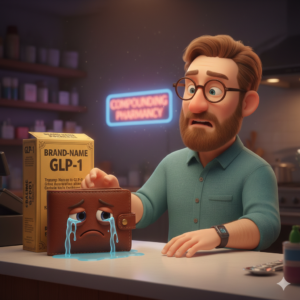
When patients cannot access approved medications due to cost, they seek alternatives.
Not because they’re reckless. Not because they’re trying to game the system. Because they want treatment.
Hims & Hers marketed compounded semaglutide at a fraction of brand-name prices. For some patients, that wasn’t about convenience, it was about finally being able to participate in modern metabolic care.
If those lower-cost options disappear without broader affordability solutions, the access gap widens again.
Metabolic disease does not pause while legal or regulatory processes unfold.
The System Created This Tension
Compounded GLP-1 products gained traction during drug shortages, when demand dramatically outpaced supply.

Now demand remains high, pricing remains complex, and patients continue searching for accessible care. It is a reflection of how breakthrough science, market forces, regulation, and reimbursement systems intersect.
This lawsuit is not simply about who is right or wrong. It highlights a broader systemic reality:
We have breakthrough science. We have demand. We have outcomes data. We have demand. But we do not have universal affordability. And until affordability and coverage are addressed more consistently, friction between pharmaceutical companies, telehealth platforms, compounding pharmacies, regulators, insurers, and patients will likely continue.
So Is This Good or Bad?
It depends on your lens:
- From a safety lens, reinforcing FDA oversight and manufacturing consistency is positive.
- From an access lens, limiting lower-cost alternatives without parallel affordability solutions presents challenges.
- From a patient lens, it can feel frustrating that life-changing therapies can be both revolutionary and financially out of reach.
The Real Question
Why are so many patients turning to compounded alternatives in the first place?
If FDA-approved medications were broadly accessible and affordable, the demand for copycat versions would shrink dramatically.
Patients do not wake up hoping to bypass regulatory systems. They wake up wanting:
- Stable blood sugars
- Sustainable weight management
- Reduced health risks
- A plan they can actually afford
That shouldn’t feel radical.
My Perspective
As someone who works in diabetes care, I believe two things can be true at the same time:
Patients deserve medications that are safe, consistent, and evidence-based. AND Patients deserve affordable access to those medications.
This lawsuit may reinforce safety standards. But unless affordability and coverage challenges are addressed alongside safety considerations, the broader intent may be misunderstood.
The future of obesity and diabetes care should not be shaped solely in courtrooms. It should be shaped by policies and collaborative solutions that make breakthrough therapies both safe and accessible, without forcing patients to choose between innovation and affordability.
Because metabolic health is complex enough. Access to treatment should not add unnecessary complexity.