

There’s a moment that sneaks up on you, but then hits you with the force of Mike Tyson in his prime (in the early part of his career, most fights with Iron Mike didn’t make it past the first round).
It doesn’t happen when you first get diagnosed.
It doesn’t happen when you first learn to count carbs.
And it definitely doesn’t happen when you open the box for your first insulin pump or continuous glucose monitor (CGM).
In fact, at the beginning, the technology feels like the hard part of diabetes.
Buttons. Alerts. Settings.
Basal rates. Correction factors. Insulin-to-carb ratios.
Bluetooth signals between pump and CGM.
Trend arrows, which are helpful until they suddenly feel like they’re judging you.
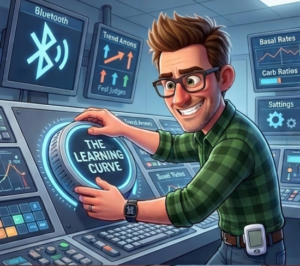
You assume: If I can just learn how to use this thing, I’ll be set.
And to be fair, that’s not wrong. There’s a learning curve. There’s a lot to figure out. And getting comfortable with diabetes technology is no small task.
But eventually, quietly, almost unexpectedly, you hit a different realization:
And then it hits you:
The technology isn’t the hard part. Life with diabetes is.
The Promise of Technology
Modern diabetes technology is incredible.
Insulin pumps can adjust delivery in real time.
CGMs can show you where your glucose is going before you even feel it.
Algorithms can suspend insulin, correct highs, and smooth out fluctuations that used to feel inevitable.
If you had described this level of control to me 20 years ago, I would have thought you were crazy. It still amazes me that I spent the first 21 years of diabetes without a pump.
And yet…
People still struggle.
Blood sugars still swing.
Frustration still builds.
Burnout still happens.
There was a study in 2022 that showed A1Cs have stayed generally the same over the last 20 years—despite more progress in diabetes technology than the 80 years prior.
So what gives?
The Real Work Happens Between the Data Points
Technology gives you information. And although it can make some decisions for you, they are limited.
There are a whole host of decisions, however, that you alone must make.
Every number, every alert, every trend arrow is a prompt:

Do I correct this?
Do I wait?
Was that meal underestimated?
Is this stress? Lack of sleep? A bad site?
Or did I just think I could “eyeball” those carbs and get away with it?
These decisions don’t happen once or twice a day.
They happen dozens of times.
Hundreds, in fact.
A commonly cited estimate suggests that people with diabetes make around 180 decisions every day related to their condition.
And they’re not made in a vacuum.
They’re made:
While you’re working
While you’re driving
While you’re trying to sleep
While you’re just trying to be a normal person for five minutes
This is where the real challenge lives.
Not in the device.
In the decisions.
Knowing vs. Doing
As a diabetes educator, I can explain exactly what to do in most situations.
As someone living with diabetes, I can tell you I don’t always do it.
I know I shouldn’t overcorrect a low, but I do.
I know I should pre-bolus more consistently, but I don’t.
I know that changing a questionable infusion site early is better than waiting, but I wait.
And yet…
Sometimes I eat a little extra “just to be safe.”
Sometimes I forget to bolus with my meal… and remember halfway through.
Sometimes I wait on the site change because it’s inconvenient right now.
This isn’t a knowledge problem.
It’s a human problem.
Habits, Not Hardware
The biggest gains in diabetes management rarely come from a new device.
They come from small, repeatable habits:
Pre-bolusing (even just a few minutes earlier)
Checking trends instead of reacting to single numbers
Changing your site when things don’t add up (after ruling out everything else)
None of these require new pump technology.
But all of them require consistency.
And you know what? Consistency is hard.
The Emotional Layer No One Talks About Enough
Technology is logical. Diabetes is not.
You’re playing a game with something that is not playing by the rules.
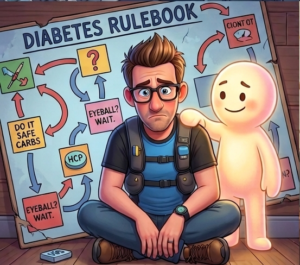
You can do the same thing two days in a row and get completely different results.
You can make the “right” decision and still end up out of range.
You can feel like you’re doing everything right, and still feel like you’re failing.
That disconnect wears on you.
It leads to:
Frustration
Second-guessing
Decision fatigue
Burnout
No algorithm fully accounts for that.
More Diabetes Tech Isn’t Always the Answer
When things aren’t going well, the instinct is often:
Maybe I need a better system.
A newer pump.
A different sensor.
A more advanced algorithm.
And sometimes that helps. But more often than not, it doesn’t.
Because if the underlying challenges are:
Delayed decisions
Inconsistent habits
Mental fatigue
Emotional overwhelm
Then more technology doesn’t solve the problem, it just gives you more data about the problem… sometimes more than you actually wanted to know.
So What Actually Helps?
If the hard part isn’t the technology, then what moves the needle?
A few things tend to make a bigger difference than we expect:
First, find your people. Find them in person, on Reddit, on Facebook. Talk and share with others about your diabetes, and let them do the same. That alone will help bring the tension down.
1. Building default habits
Even small routines can reduce mental load. Try to eat meals (or just one meal) at the same time every day, and set an alarm on your phone to remind you to pre-bolus.
2. Recognize signs
Step back from the situation and view it as an educator would. An elevated blood glucose that you can’t explain and hasn’t come down from two corrections, change that bad boy out.
3. Being honest about what’s working (and what isn’t)
For the most part, the pump should handle carb and correction boluses without overrides, and if you’re doing it too often, you need to talk to your HCP. I keep track of my overrides on my kitchen calendar,
A Different Way to Think About It
Technology is a tool.
A powerful one. A helpful one. Sometimes even a life-changing one.
But it’s still just a tool.
The real work of diabetes management lives in:
You’re ability to share.The choices you make
The habits you build
That’s the part no device can fully automate.
The Takeaway
There’s nothing wrong with wanting better technology.

But there’s also nothing wrong with recognizing that even the best technology won’t remove the human side of diabetes.
And maybe that realization, frustrating as it can be, is actually freeing.
Because it shifts the goal.
From: “I need to master this device.”
To: “I need to find a way to manage this in real life.”
And those are two very different things.
Because in the end, managing diabetes isn’t about having perfect technology.
It’s about making imperfect decisions… a little better, a little more often.
Apply It
Pick one small habit (not a new device) to focus on this week
Look for patterns, not perfection
The next time something doesn’t go as planned, ask: Was this a technology issue, or a decision moment?
Because more often than not…
You’ll already know the answer.